Beyond the airstrip: the latest technology and innovation
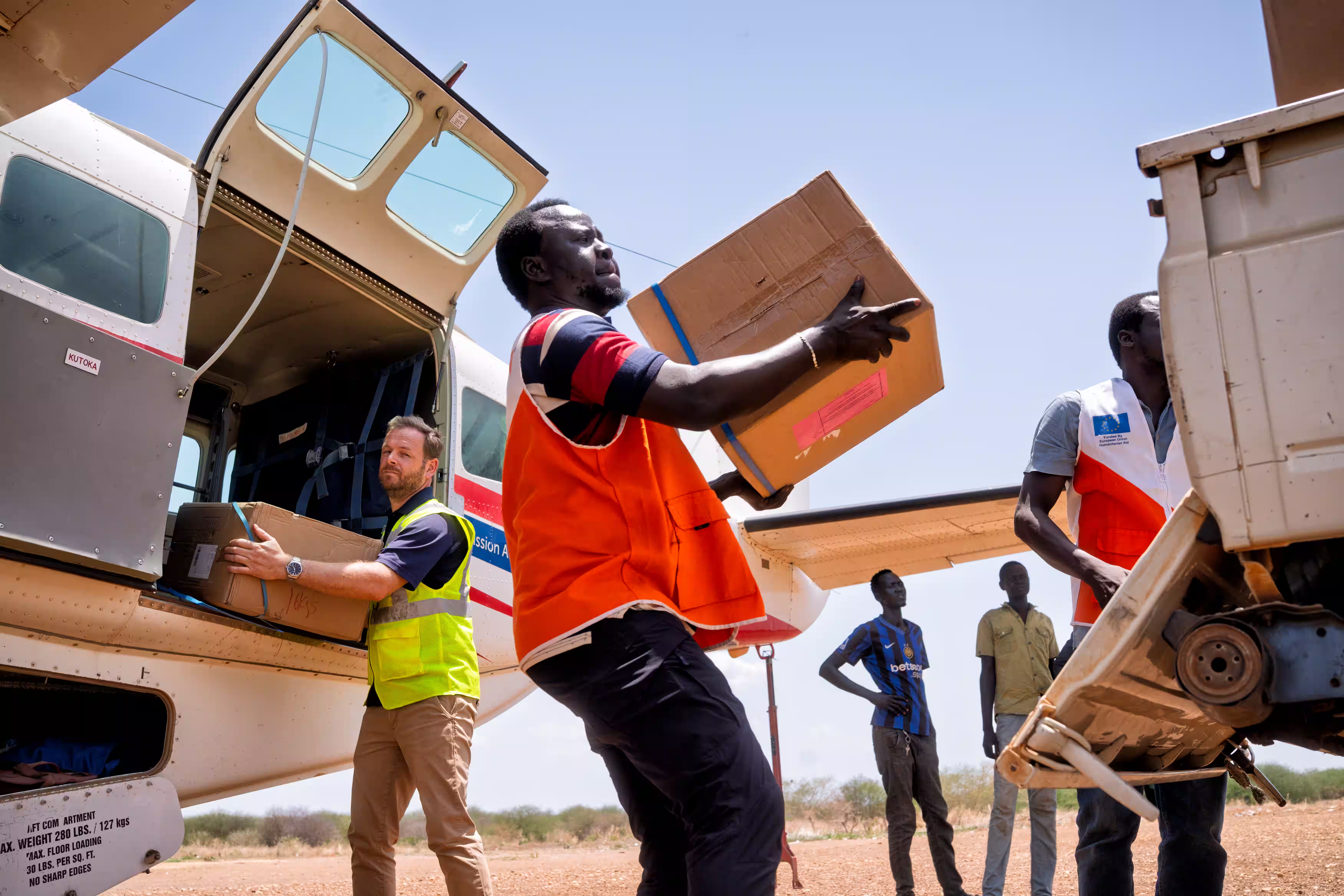
MAF reaches some of the most remote places on earth by aeroplane. But where there is no airstrip, help often stops at a geographical limit. New drone technology could change that – and reach people who have been cut off until now.
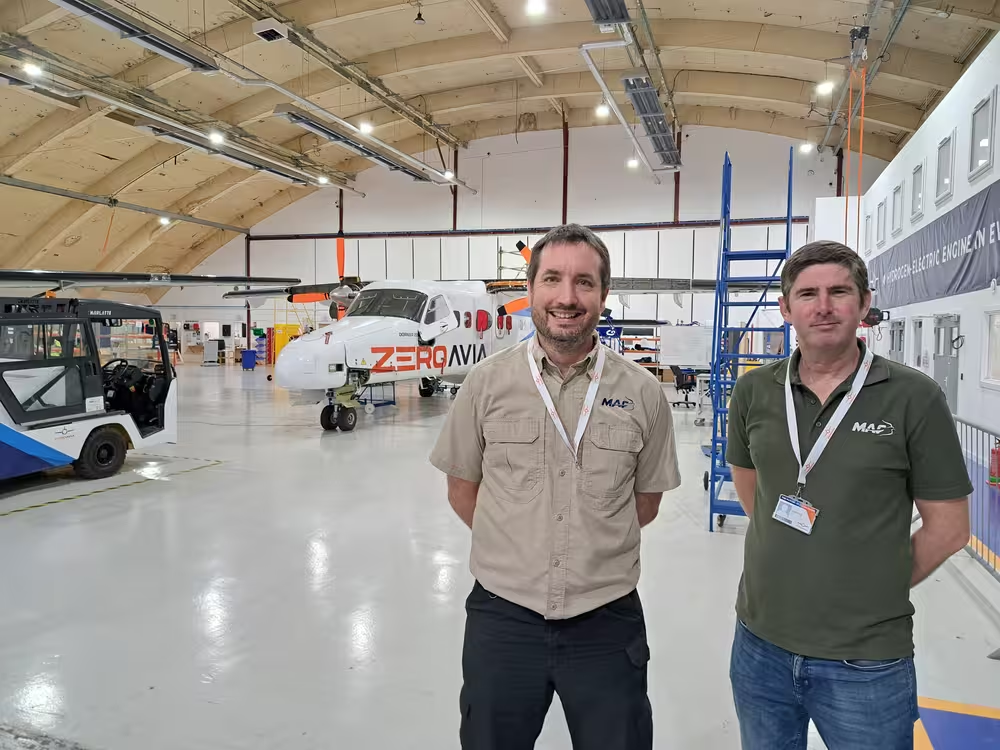
When a remote health post runs out of medicines, lacks spare parts or urgently needs relief supplies, every hour counts. MAF can reach many of these places by aeroplane. But some are so isolated that not even an aeroplane can land there. That is exactly where Dave Waterman’s vision begins. He has worked for MAF since 2017, first as an engineer in Uganda and Liberia. Today, as project manager for fleet innovation, he leads the search for new technical solutions.
“When I joined MAF, I thought the aeroplane made everything possible,” says Dave. “But I have learned that an aeroplane is only a tool. What matters are the people and the help that reaches them.” Until now, one thing above all has set the limits: the lack of an airstrip. “With drones you no longer need an airstrip. So the question is: can we go further? Can we do more? If we get beyond the airstrip, we can break through isolation.”
Dave knows what uncertainty means for people in remote regions. When supplies run low in a small clinic, staff have to decide who they can help first – and who they cannot. A drone could considerably shorten that agonising wait. Smaller deliveries could be flown in from the air, straight to places that are hard to reach.
“A lot of this is about dignity,” says Dave. “When supplies are running low in a small health post, there should never be a shortage in the first place. People should be able to help there knowing that more supplies are on their way.” Many people associate drones either with leisure gadgets or with weapons. Dave is therefore looking specifically at systems suited to humanitarian work – robust, reliable and usable in difficult conditions.
In doing so, MAF is picking up its own history. The organisation’s founders also once used wartime technology for a new purpose: reaching people in remote regions. “In six to twelve months we will know whether this is realistic for us,” says Dave. “At every step we keep asking ourselves whether this technology really does what we need. If it does, we could launch a pilot project in about three years.”
By 2030 MAF could – provided the benefits are confirmed – be operating its own drones. For Dave, though, one thing is clear: drones will not replace MAF’s pilots. Aeroplanes remain indispensable, especially when people have to be transported or larger loads moved. “It is about choosing the right tool for each task,” he says. “The Cessna Caravan is very efficient when people and cargo have to be taken to several places. For smaller deliveries under 300 kilograms, a drone can make more sense. If a water filter breaks down in a remote village, a spare part could be there in a short time.”
But what drives Dave is not the technology itself. “In the end, what matters least to me is which tool we use. What counts is that help arrives – and with it hope and healing.”
Innovation fact sheet
MAF is currently assessing a range of emerging technologies. Dave Waterman explains how suitable they could be for use in remote regions:
· Sustainable aviation – The right tool for each task delivers the best results, especially in the difficult conditions in which we work. Smaller aircraft generally produce less CO₂. At the same time, larger aircraft are also more efficient when fully loaded – measured in emissions per kilogram of cargo.
- Drones – They are particularly well suited to places without an airstrip, whether by landing vertically, by air-dropping, or where there is only room for a very short runway. This could become an important area of growth for MAF: aeroplanes take goods to remote regions, drones cover the last stretch to their destination.
- Hybrid eVTOL – These are long-range versions of the “air taxis” being talked about so much at the moment. We are looking at models that can also take off and land conventionally. They could close the gap between smaller versatile aircraft and the Cessna Caravan. They are electrically powered but also have a fuel-driven generator to extend their range.
- Electric propulsion – MAF is following this development closely. For many of the countries where we work, the technology is currently still of limited use – among other reasons because of unreliable power supplies and restricted payload and range. Possibilities for training aircraft are being examined, however, depending on how batteries develop.
- Hydrogen – This technology is also being monitored. Challenges currently remain around range and payload, as well as the infrastructure for producing and storing hydrogen.
- Alternative aircraft types – New kinds of aircraft are currently being developed and brought to market. MAF keeps reviewing them and is considering them for future operations.
How the MAF magazine changed my life
Dave Waterman describes what moved him to become an engineer and later to serve with MAF. “Aviation has always fascinated me. There are photos of me as a boy out flying microlights with friends,” he says.
“When I was 13, someone who knew about my interest in aviation introduced me to MAF. In the magazine I saw an advertisement: we are looking for aircraft engineers. And I had the impression that God was calling me to exactly that. I didn’t apply straight away at the time, but I contacted MAF immediately and asked: what do I have to do to get there? That gave my life a direction – through my studies, the qualifications I needed as an aircraft engineer and every further step towards that goal.”